
Nearly a full year has passed since former Hezbollah Secretary-General Hassan Nasrallah was eliminated on September 27, 2024, but his spiritual and symbolic presence continues to dominate the terrorist organization and its supporters throughout Lebanon and beyond. The calls “At your service, Nasrallah” still echo in demonstrations across Beirut and southern Lebanon, while his successor Naim Qassem struggles to fill the enormous void left by the mythological leader.
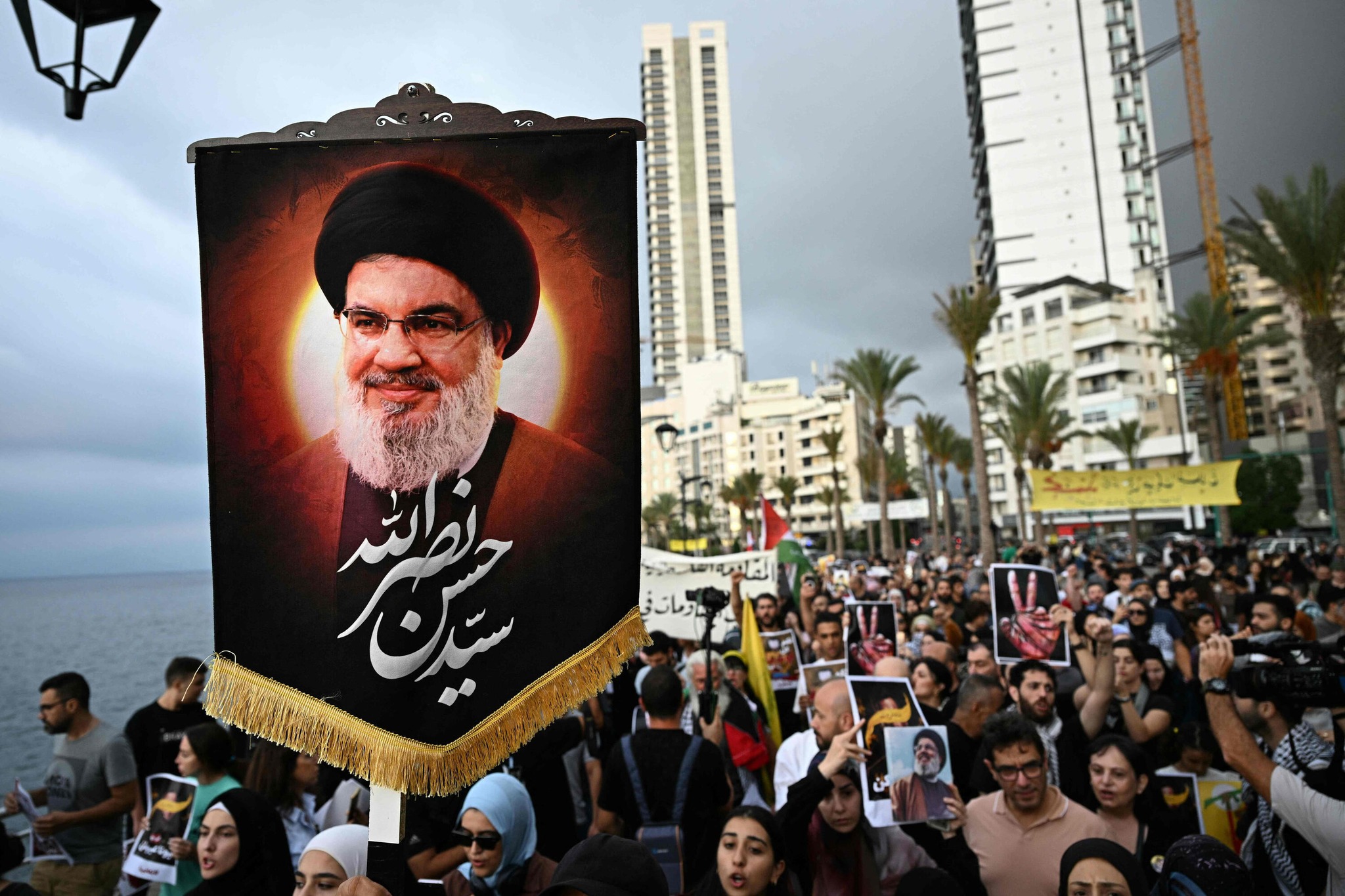
Nasrallah, who led Hezbollah for over three decades, left behind a complex legacy and a figure that became a symbol among the organization’s supporters. His portraits continue to flutter in demonstrations in Beirut and Dahieh, on building walls and in public spaces in southern Lebanon villages, al-Bekaa and Shiite strongholds. These sights testify to the fact that although his body was killed, his spirit and authority continue to live among his believers.
Nasrallah’s successor, Naim Qassem, a veteran member of Hezbollah’s leadership since its establishment in the 1980s, finds himself in a long and oppressive shadow. Despite delivering many speeches since his appointment as Secretary-General and presenting himself as a strong and determined leader, his predecessor’s popularity and authority still outweigh his own. At every demonstration and mass event, the calls are repeated again and again: “At your service, Nasrallah” – living testimony that the spiritual leadership is still perceived as belonging to one who is no longer alive.
Nasrallah’s image receives special cultivation by his son, Mahdi Nasrallah, who in recent years has developed for himself an image as a religious authority. Mahdi, who opened channels on social networks and dresses exactly the same way his father dressed, succeeds in attracting attention to himself and harnessing the nostalgia around his father to build status and influence for himself. Even if his influence is modest compared to what his father had, he becomes a significant factor in preserving his memory.
Ahead of the first anniversary of his elimination, Mahdi managed to stir up turmoil among his father’s admirers and confuse them. On September 10, he hinted that he would publish a video “that will make Nasrallah’s lovers happy”, and this led to rumors on social networks that his father was still alive. The confusion was so great that the next day he was forced to publish a clarifying statement: “Hezbollah and we, his family, have clarified again and again that he was killed. There is no place for manipulations, checks or lies on this matter”. A day later he published the promised video and revealed the “surprise” – a new book called “My Memories with My Father”, which is already available for purchase in Lebanon and expected to be released in Iraq as well.
Since the elimination, two main centers have become sites associated with Nasrallah’s figure and pilgrimage centers for his supporters in the past year. The first is the elimination site in Haret Hreik in Dahieh in Beirut, which previously served as Hezbollah’s central headquarters. The site, which remained in the ruins of the attack, became a pilgrimage center for the organization’s supporters, who come to visit the tragic point where their leader was killed. In recent months, mass events and support demonstrations by Hezbollah supporters were held at the site, alongside the attack ruins that remained as a tangible memory of the events of that fateful day.
The second center, and perhaps the more important one, is Nasrallah’s burial site – a shrine located between the two roads to Rafik Hariri Airport in Beirut. The shrine quickly became a central pilgrimage center, and not only for Hezbollah supporters from Lebanon. The site attracts visitors from across the Shiite world and has become a strong symbol of resistance to Israel and the West.
The high-level visits to the shrine emphasize its geopolitical importance. Iran’s Supreme National Security Council Secretary Ali Larijani arrived at the shrine last August and declared from there: “We will always stand by your side. We do not interfere in the internal affairs of other countries, but we confirm our support for resistance movements around the world”. This message clearly conveyed the continuation of Iranian commitment to supporting Hezbollah even after Nasrallah’s death.
Iranian Foreign Minister Abbas Araghchi also came to visit the shrine during his visit to Lebanon last June, and said from the place: “Israel’s defeat is certain. Nasrallah’s blood will ensure this victory”. These statements testify to the Iranian desire to turn the shrine into a symbolic center of the struggle against Israel, and to use Nasrallah’s figure as a unifying symbol for what Iran calls the “axis of resistance”.
The shrine itself quickly became a complex problem for the Lebanese government, which struggles to deal with the massive presence of visitors and with the de facto status that the place has acquired. The tension around the shrine expresses the broader struggle between the Lebanese government and Hezbollah over control of public space and over the state’s identity.
In the coming week, with the approach of the first anniversary of the elimination, there are concerns in Lebanon about a possible Israeli response. Some estimate that IDF aircraft might be present in Lebanon’s atmosphere in these days, as part of the messages Israel wants to convey in this sensitive period. The fear is that Israel will use the anniversary opportunity to demonstrate power or intervene in the memorial events that Hezbollah plans to hold.
Hezbollah itself is preparing to mark the anniversary with special events throughout its strongholds. The expectations are that the events will be massive and will serve not only as commemoration of Nasrallah, but also as a demonstration of the organization’s power and its continued ability to mobilize masses despite the severe blows it suffered in the past year.
The complexity of the situation stems from the fact that Nasrallah became a symbol that transcends the boundaries of Hezbollah itself. His figure is perceived among many Shiites in Lebanon and beyond as a symbol of resistance to Israel and the West, and his death turned him into a kind of saint for his believers. This reality creates a complex challenge for his successor Naim Qassem, who is forced to maneuver between the need to honor his predecessor’s memory and the need to establish his status as an independent leader.
Qassem’s difficulty in filling Nasrallah’s big shoes is expressed not only in the popularity gap, but also in operational difficulties the organization experiences. Hezbollah faces heavy internal and external pressures, and the new leadership is forced to navigate between high expectations from supporters and practical limitations in the field reality.
The fact that the calls “At your service, Nasrallah” continue to be heard in demonstrations testifies that in many people’s eyes, the organization’s spiritual and symbolic leadership is still in the hands of the dead, while the practical leadership deals with daily challenges. This situation creates a complex dynamic that could affect Hezbollah’s ability to operate effectively in the coming period.
The year that has passed since Nasrallah’s elimination has proven that although his body was killed, his spiritual and symbolic influence is stronger than ever. The struggle over his legacy continues, and the question is whether his successor will eventually succeed in emerging from his long shadow and establishing independent leadership, or whether Nasrallah’s figure will continue to dominate the organization in the coming years as well.