
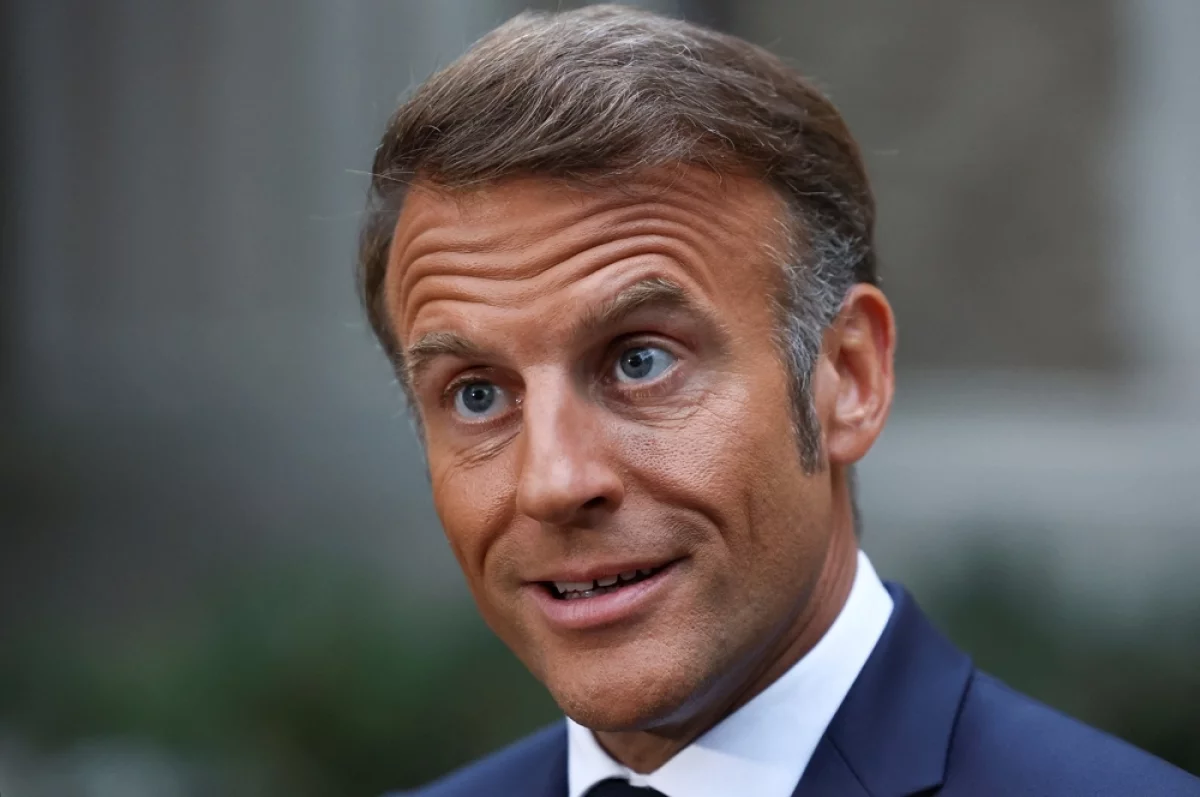
While France faces a massive wave of protests and a deep political crisis, President Emmanuel Macron continues to focus on foreign affairs, particularly the Palestinian-Israeli issue. Eighteen hours ago, Macron published a statement announcing a joint international initiative with Saudi Arabia to advance the two-state solution.
“Today, under the leadership of France and Saudi Arabia, 142 countries adopted the New York Declaration for the implementation of the two-state solution. Together we are charting an irreversible path toward peace in the Middle East”, Macron wrote on social media. The French president added that “France, Saudi Arabia and all their partners will be in New York to turn this peace plan into reality, within the framework of the conference on the two-state solution. Another future is possible. Two peoples, two states – Israel and Palestine – living side by side in peace and security. It depends on all of us to make this happen”.
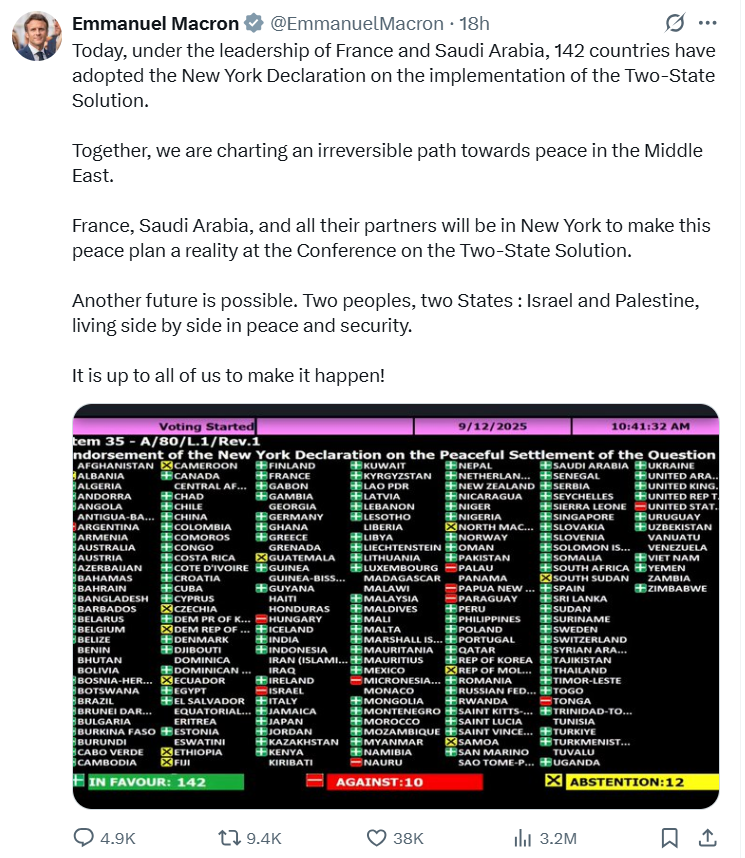
The initiative arrives amid visibly strained relations between Paris and Jerusalem. Not long ago, the Israeli Prime Minister refused to receive Macron in his office, a rare diplomatic rebuff underscoring the rift between the two governments. Macron’s difficult relations with Israel are also reflected in his social media activity, where he devotes significant attention to issues concerning Ukraine and Palestine.
On September 11, Macron posted a photo on X with a message referring to the Israeli hostages: “We do not forget Nimrod Cohen, Avitar David, Guy Gilboa Dalal, Guy Iluz, nor any of the hostages still held by Hamas in inhumane conditions. France continues to work tirelessly for their immediate release. This is a top priority commitment”.
On one hand, Macron makes public statements about the hostages; on the other, he extends gestures of support for Hamas, the organization responsible for their abduction. The contrast suggests a disconnect between his positions, leaving observers questioning his approach and even his judgment.
At the same time, Macron’s focus on foreign diplomacy unfolds as France itself experiences one of its most severe internal crises in recent years. The country has been gripped by the “Block Everything” movement, a wide-scale protest campaign that has led to hundreds of arrests in clashes with police. Demonstrators have expressed growing anger over the rising cost of living and austerity measures promoted by Macron’s government.
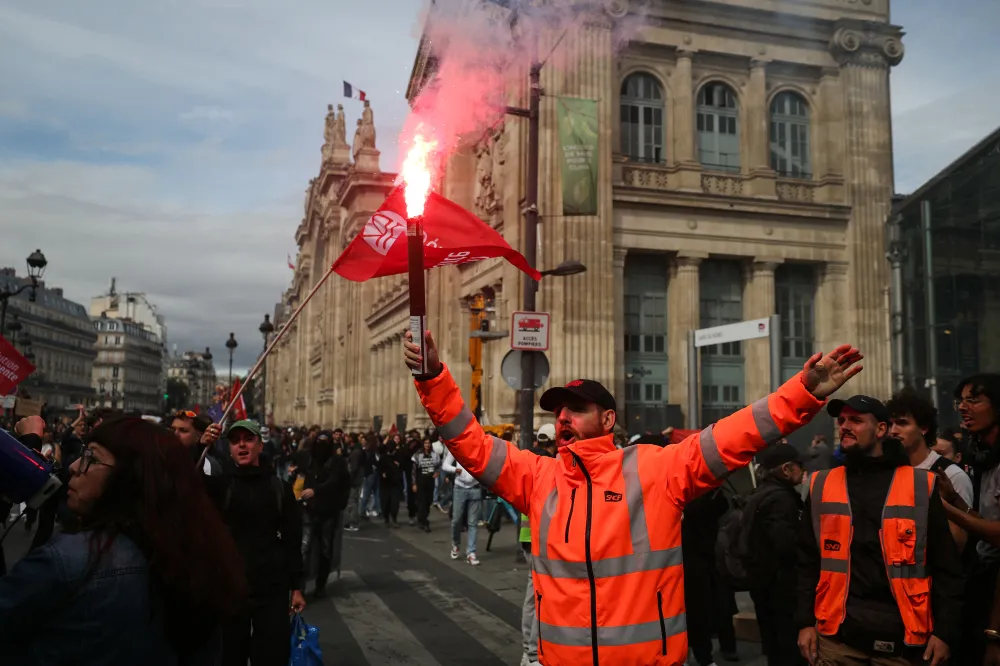
The political instability reached its peak with the dissolution of François Bayrou’s government after less than nine months in office and the subsequent appointment of Sébastien Lecornu as the new Prime Minister. Protesters blocked major roads across the country, and French police deployed tear gas in multiple cities and towns to disperse demonstrations.
French Interior Minister Bruno Retailleau reported the arrest of nearly 600 people during the initial stages of the “Block All” demonstrations. Authorities warned that as night fell, the protests risked spiraling into violent riots.
In Paris, students clashed with police near the Sorbonne University, blocking traffic on major roads. The crisis spilled over into the healthcare system, where workers launched strikes, forcing several hospitals into emergency operating mode due to staff shortages. Public transportation was also heavily disrupted, with metro services facing significant interruptions.
Macron’s prioritization of international diplomacy in the midst of such upheaval raises growing questions about his leadership. Millions of French citizens are struggling with the cost of living and ongoing political instability, yet the president dedicates significant time and resources to resolving Middle Eastern conflicts.
The joint initiative with Saudi Arabia further stirs debate about France’s foreign policy orientation, its diplomatic alignments, and the influence of the country’s large Muslim population on its external policies. The New York Declaration, endorsed by 142 countries, places France and Saudi Arabia at the forefront of efforts to promote the two-state solution.
The stark contrast between Macron’s engagement abroad and France’s turmoil at home underscores a paradox: the president seeks to promote peace in the Middle East while his own nation descends into unrest. The upcoming New York conference on the two-state solution will test Macron’s ability to sustain his diplomatic standing internationally while contending with domestic instability.
On Macron’s own social media feed, the imbalance is striking. His attention is overwhelmingly devoted to Israel and Palestine, with occasional references to Russia and Ukraine, but virtually no mention of France’s domestic protests, the collapsing government, or the daily hardships faced by French citizens. The silence has only intensified criticism of a president increasingly perceived as detached from the reality of his own country.
As the unrest deepens, the question of Macron’s priorities grows sharper. Can a president maintain credibility abroad while leaving crises unresolved at home? For many in France, the answer seems clear. The demonstrations, arrests, and widespread anger are symptoms of a nation losing confidence in its leadership. It is perhaps no surprise that more and more citizens openly speak of replacing a president they view as powerless.