
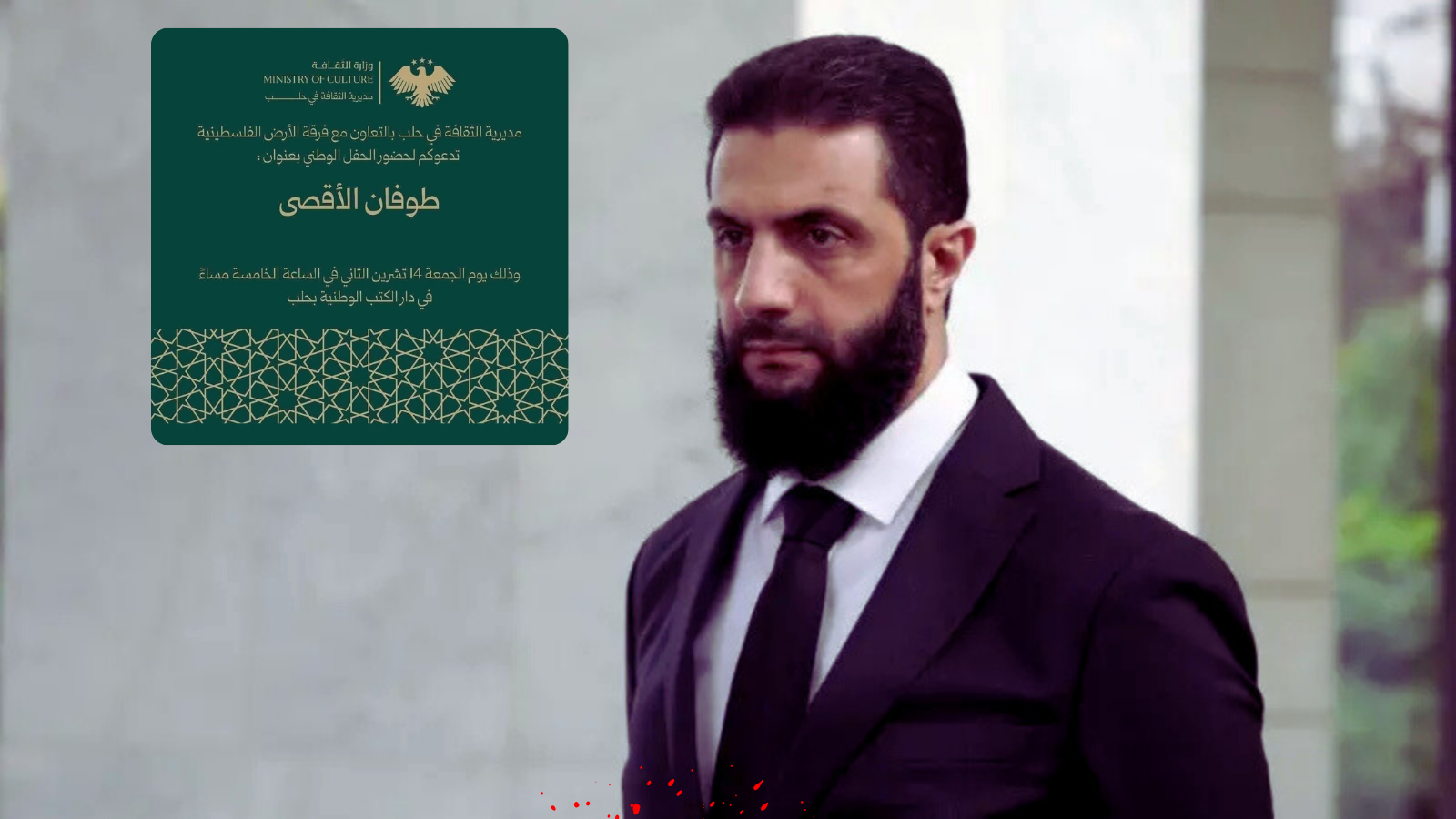
Israel’s Foreign Ministry issued a sharply-worded condemnation of Syria on Thursday, November 14, 2025, following reports that the Syrian government is organizing an official event to commemorate the October 7, 2023 Hamas attack on Israel. The ministry’s statement, published on its official X account, directly targets Syrian President Ahmad al-Sharaa, widely known by his nom de guerre Abu Mohammad al-Julani, accusing him of deliberate deception in his dealings with the international community.
“Syria’s president, al-Julani, speaks of a ‘new Syria,’ but at the same time his Culture Ministry is inviting the public to a national party marking the October 7 massacre – the largest massacre of Jews since the Holocaust, celebrated there under the name ‘Al-Aqsa Flood'”, the Foreign Ministry declared. The statement continued with an unambiguous warning: “Anyone who celebrates a massacre – wants more massacres, not change”.
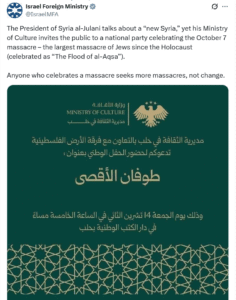
The controversy centers on an event reportedly organized by Syria’s Culture Ministry using the name “Al-Aqsa Flood” – the operational designation Hamas assigned to its October 7, 2023 assault on southern Israel. That attack resulted in the deaths of approximately 1,200 people and the abduction of more than 250 hostages into the Gaza Strip, marking one of the deadliest days in Israeli history. The fact that an official government ministry under the new Syrian administration is publicly promoting an event commemorating the attack has prompted Israel to question the authenticity of Damascus’s recent diplomatic overtures.
Al-Julani assumed power in Syria following the collapse of Bashar al-Assad’s regime and has since embarked on a calculated effort to rehabilitate Syria’s international image. He has conducted meetings with foreign dignitaries and dispatched conciliatory messages to the Trump administration in Washington, emphasizing his commitment to regional stability and his desire to usher Syria into a new era of peaceful international relations. His carefully crafted public persona has been that of a pragmatic leader ready to break from Syria’s troubled past.
The planned cultural event, however, appears to directly contradict this narrative. Israel contends that the Syrian Culture Ministry’s decision to host a celebration of the October 7 attack reveals the true ideological orientation of the new regime. According to Israeli officials, the event exposes a fundamental disconnect between al-Julani’s diplomatic messaging abroad and the reality of his government’s positions at home.
The Israeli Foreign Ministry’s statement serves as a pointed alert to the international community, particularly to the United States under President Donald Trump, urging Western powers not to accept the Syrian regime’s professed moderation at face value. Israel argues that the new Syrian government is deliberately misleading American and European officials by presenting a facade of peace and reconciliation while simultaneously endorsing acts of terrorism against Jews and Israelis within its own borders.
The timing of Israel’s statement is significant. As Syria attempts to emerge from more than a decade of catastrophic civil war, al-Julani’s government has been actively seeking international recognition, economic assistance, and the lifting of sanctions. The regime’s success in these efforts depends heavily on its ability to convince Western powers that it represents a genuine departure from the extremism and violence that have characterized Syrian governance in recent years.
The allegations contained in the Israeli Foreign Ministry’s statement, if substantiated and widely circulated in international diplomatic circles, could prove severely damaging to Syria’s rehabilitation efforts. Western governments, already cautious about engaging with a leader who has historical ties to extremist organizations, may view the Culture Ministry’s event as evidence that al-Julani’s proclaimed transformation is superficial rather than substantive.
The Israeli statement frames the issue in stark terms: this is not a reformed Syria seeking peaceful coexistence with its neighbors, but rather “a new enemy” – a successor regime to Assad’s that maintains the same fundamental hostility toward Israel and the same ideological affinity for violence against Jewish civilians. By characterizing the event as a celebration of “the largest massacre of Jews since the Holocaust”, the Foreign Ministry draws a direct line between the Syrian government’s actions and the darkest chapters of 20th-century history.
The controversy highlights the complex challenges facing international policymakers as they navigate Syria’s post-civil war landscape. Al-Julani’s dual messaging – offering olive branches to Washington while his government allegedly promotes events glorifying attacks on Israeli civilians – presents Western officials with a difficult calculus. The question now facing the Trump administration and other Western powers is whether to accept Syria’s diplomatic assurances or to heed Israel’s warnings about the regime’s true character and intentions.