
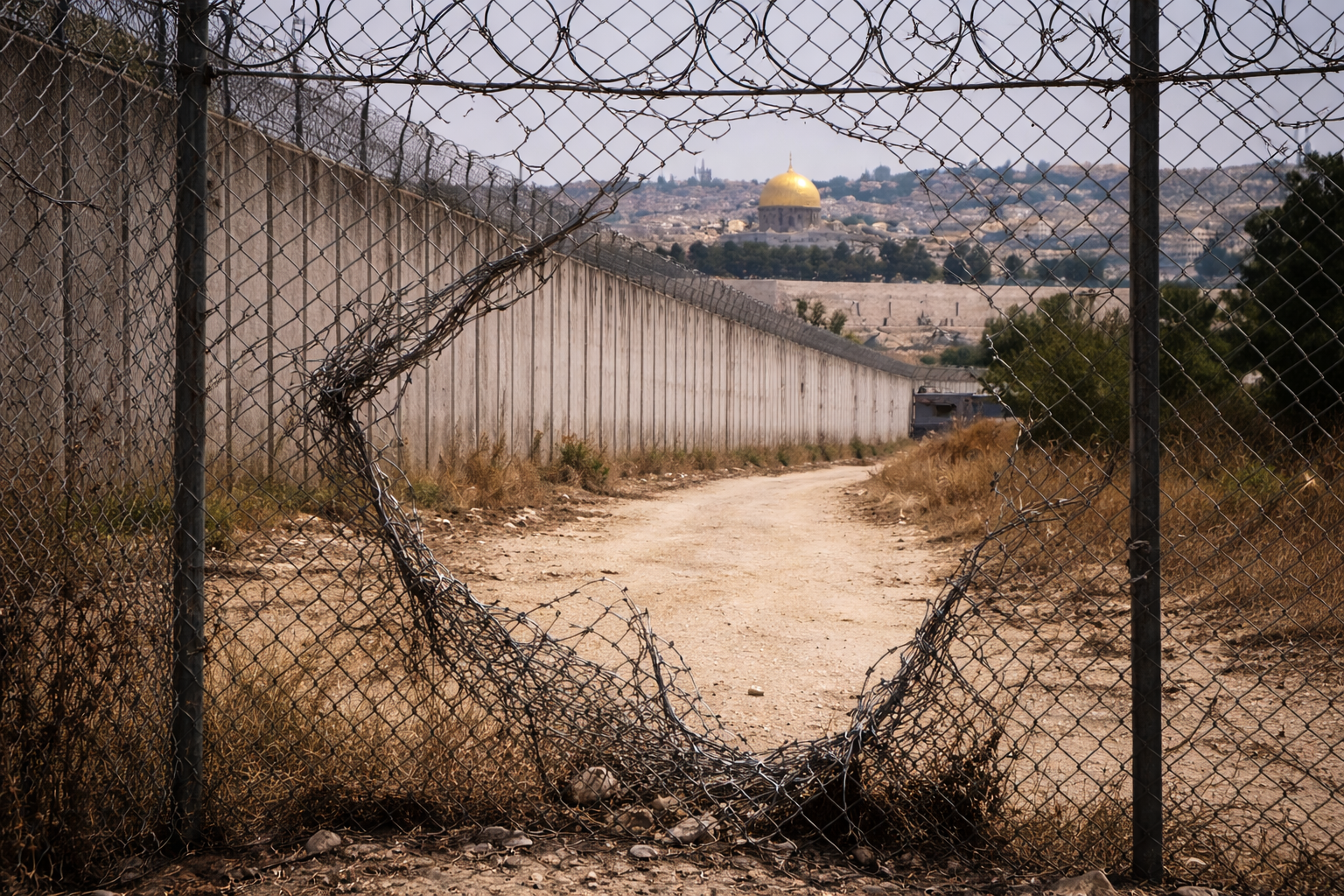
On 23 December 2025, the State Comptroller published a sharp and critical report examining the effectiveness of the seam-line barrier and the crossings in the Jerusalem envelope sector. The findings present a grave and complex security picture that directly affects the protection of Israel’s capital, its surrounding communities, and national security as a whole. According to the report, the barrier – designed to serve as a physical and operational buffer against terrorist infiltration and illegal entry – fails to provide a continuous, orderly, and comprehensive response to the security threats emerging from the area, despite investments amounting to billions of shekels and years of accumulated operational experience.
The audit establishes that in several significant segments of the barrier route around Jerusalem, Palestinians are able to enter Israeli territory without oversight or inspection. This vulnerability, the report stresses, is not theoretical. Terrorist attacks have exploited gaps and the absence of a continuous barrier, including the deadly attack at the Ramot Junction in Jerusalem in September 2025. Only about 61 percent of the seam-line route in the Jerusalem envelope is protected by a wall or fence, while dozens of kilometers remain breached or entirely open. The route spans several hundred kilometers, parts of which pass through Judea and Samaria and do not fully overlap with Jerusalem’s municipal boundaries. East of the barrier, areas outside its route remain within the city’s jurisdiction, creating a compounded security, operational, and legal challenge.
The report highlights serious deficiencies at the crossings themselves. A limited number of lanes at various sites creates heavy congestion for pedestrians and vehicles, disrupting daily life and, more critically, generating acute security risks. In emergency scenarios, the crossings could become lethal choke points. Data reviewed during the audit show that at the Qalandiya crossing, average pedestrian waiting times reach approximately 80 minutes, while vehicles wait around 56 minutes. In 2022, about 135,000 pedestrians passed daily through crossings in the Jerusalem envelope. Between 2018 and 2022, traffic increased by roughly 53 percent, without corresponding upgrades to crossing infrastructure.
Organizational and operational failures are a central theme of the report. Coordination between the police, the Israel Defense Forces, the Border Police, and the Israel Security Agency is described as inadequate, with no uniform and binding operational doctrine governing the barrier and the crossings. The police have managed the crossings for nearly two decades without a structured operational concept, despite a prime minister–approved plan – formulated by the National Security Council – calling for the civilianization of the crossings. That plan envisioned clear rules, principles, and procedures, but no comprehensive doctrine has ever been approved or implemented.
Command-and-control deficiencies further compound the problem. Some crossings lack permanent command, and of the 16 existing crossings, only two commanders have been formally certified in their roles. The report finds that this situation creates management gaps, undermines routine operations, and reduces the ability to respond effectively to exceptional incidents. It also exposes a mismatch between the police’s responsibility for operating the crossings and its limited capacity to maintain, upgrade, and adapt them to sustained population growth.
Preparedness for extreme scenarios is also found wanting. Until the events of 7 October 2023, the Jerusalem District of the police lacked a defined reference threat or scenario on which force development in the Jerusalem envelope could be based. Only after those events were preparedness orders developed, with preparations completed in August 2024. Even then, the audit concludes that these measures do not provide a full operational response to the range of potential risks.
The report points to severe manpower shortages, particularly among civilian security personnel at the crossings. Neither the Ministry of National Security nor the police prepared in advance for this shortfall. With the outbreak of the “Iron Swords” war, many guards were mobilized under emergency orders, further weakening operational capacity. In parallel, the reduction in personnel of the Erez Battalion of the Military Police Corps as early as June 2023 meant the unit could execute only about 69 percent of its assigned missions, leaving nearly one-third unfulfilled.
Security threat data underscore the severity of the situation. In 2023, 27 deadly terrorist attacks were recorded in the Jerusalem envelope. During the same period, there were 10 shooting incidents targeting security forces, 412 Molotov cocktail attacks, 98 explosive-device incidents, and 1,031 stone-throwing incidents. In the first quarter of 2023, 2,427 illegal entrants were apprehended in the area, compared with 1,233 in the first quarter of 2024. The audit also identifies a significant discrepancy between infiltration records maintained by IDF observation command centers and police records based on declarations under the “Turkish Horse” order, particularly between January and May.
Infrastructure shortcomings further exacerbate operational strain. Nearly two decades after the crossings were established, only four of the 16 crossings – about 25 percent – have undergone upgrades. Although investment began in 2021 to expand four additional crossings, the report finds this progress insufficient relative to user growth. It also notes that the Ministry of Transport widened a road adjacent to the Tunnels Crossing without assessing the impact on the crossing itself or coordinating lane additions, creating bottlenecks that pose security risks to both forces and road users.
From a budgetary perspective, the report states that constructing the barrier in Judea and Samaria, including the Jerusalem envelope, cost approximately 8.3 billion shekels. Despite this expenditure, openings remain that allow illegal entry into Jerusalem, reflecting deficiencies both in the barrier’s physical continuity and in the operation of the crossings.
The audit was conducted between January 2024 and February 2025 and examined authority and responsibility among the Border Police, reference threats and scenarios, operational effectiveness, crossing doctrine, force heterogeneity, inspection procedures, infrastructure adaptation, and civilianization efforts. It involved the police, the IDF, the Ministry of Defense, the Ministry of National Security, the Israel Security Agency, the Ministry of Transport, the Prime Minister’s Office, the National Security Council, the Government Secretariat, and the Jerusalem Municipality, with supplementary work continuing until July 2025.
In February 2025, a draft was submitted to senior officials for response. The IDF and police replied in April and May. On 8 September 2025, after the audit concluded, the Ramot Junction attack killed six Israelis and injured around ten. The report states that this event further sharpens the urgency of correcting the deficiencies and implementing recommendations.
The Knesset State Control Committee subcommittee decided not to present the full report to the plenary, publishing only parts to safeguard state security under Section 17 of the State Comptroller Law. Even so, the published material reveals extensive systemic, operational, and organizational failures.
The report concludes that the seam-line barrier and the crossings are a central pillar of Jerusalem’s security. Their proper functioning is essential to preventing terrorism and infiltration while maintaining daily life. The deficiencies identified – spanning authority, preparedness, infrastructure, and doctrine – require urgent correction amid ongoing security threats and the evolving reality since October 2023.