
Russia unleashed one of its largest drone and missile barrages on Ukraine in August while world leaders gathered at the White House on Monday in an unprecedented diplomatic push to end the three-and-a-half-year war, highlighting the stark contradiction between Moscow’s stated peace intentions and its continued military aggression.
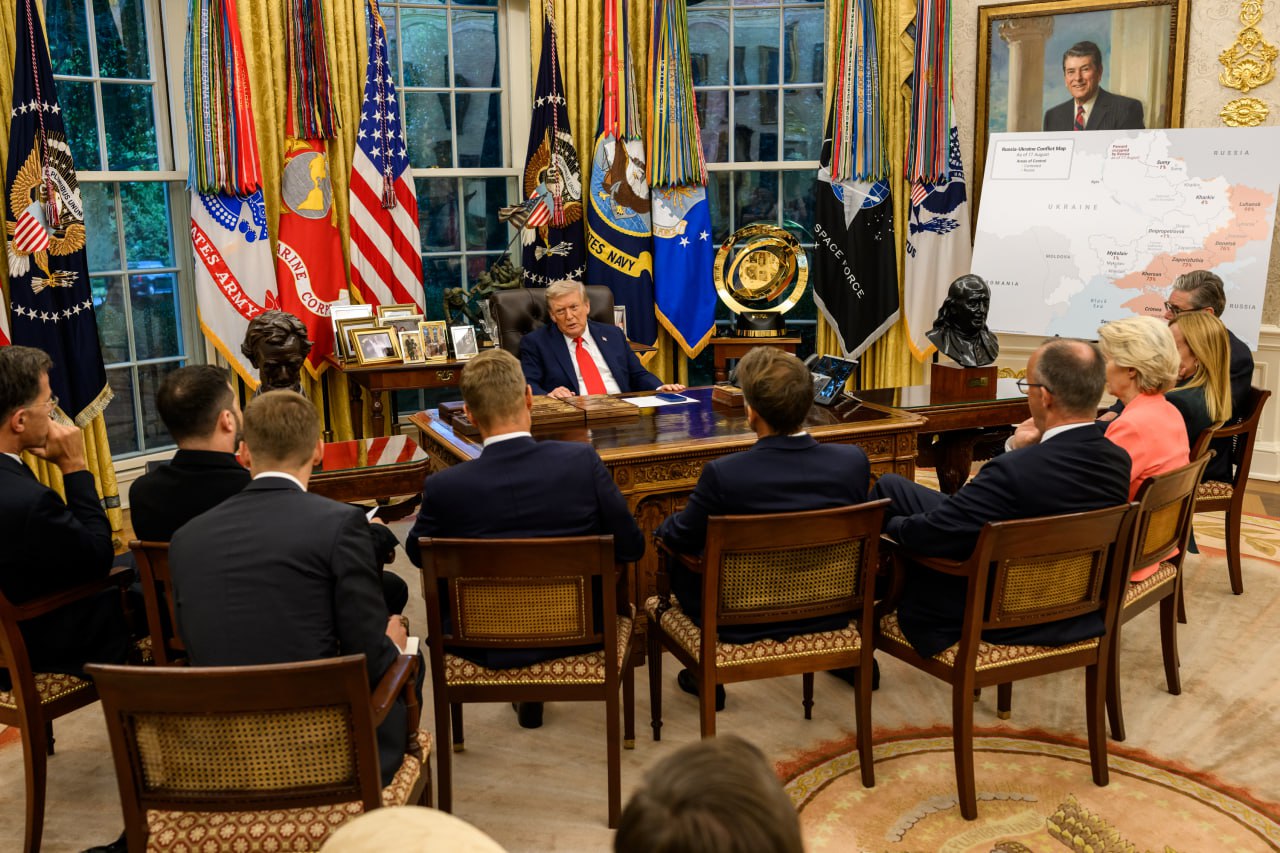
The massive Russian assault, involving approximately 270 drones and ten missiles targeting multiple Ukrainian regions with a focus on the Poltava area, occurred in parallel with and immediately following the historic Washington summit that brought together President Donald Trump, Ukrainian President Volodymyr Zelensky, and seven prominent European leaders. The timing of the attack sent an unmistakable message that Russian President Vladimir Putin remains committed to warfare despite ongoing diplomatic efforts.
Ukrainian air defense forces successfully intercepted the majority of the incoming projectiles, downing 230 drones and six missiles, but four missiles and 40 drones still reached their intended targets, striking 16 locations across the country. Interception debris caused additional damage at three sites, while the assault left hundreds of residents in the Poltava region without power after hitting critical energy and transportation infrastructure.
The White House summit represented the most significant diplomatic initiative to date aimed at resolving the conflict, with discussions centering primarily on comprehensive security guarantees for Ukraine. The meeting included detailed examination of the scope, implementation mechanisms, and operational framework for these guarantees, marking a potential turning point in international efforts to establish lasting peace.
In a dramatic development during the summit, Trump temporarily left the main discussion room to conduct a direct phone call with Putin. Following this conversation, the American president returned to brief Zelensky and the European leaders on the outcome. Shortly after the call concluded, Trump announced a breakthrough: Putin had agreed to participate in a direct face-to-face meeting with Zelensky, to be followed by a trilateral summit including Trump himself.
According to Trump’s announcement, the Putin-Zelensky meeting is scheduled to take place within two weeks, though the American president did not specify an exact location. International reports suggest Budapest as a potential venue for hosting the unprecedented encounter. The Kremlin has not yet officially confirmed Putin’s agreement to the meeting, and an official Russian statement remains pending.
The proposed meeting represents a dramatic reversal in Russian diplomatic positioning. Putin has consistently refused to recognize Zelensky as a legitimate leader and has categorically rejected any direct engagement with the Ukrainian president throughout the conflict. In contrast, Zelensky has repeatedly expressed willingness to meet with Putin under appropriate circumstances to seriously discuss ending the hostilities. Recent statements from the Ukrainian president indicated his country’s readiness to engage with Russia “in any format”, with territorial issues to be addressed at the bilateral level with Putin directly.
German Chancellor Friedrich Merz and British Prime Minister Keir Starmer both confirmed their support for organizing the meeting between the warring leaders. Merz added a cautionary note, stating, “We don’t know if the Russian president will have the courage to participate in such a summit. Therefore, persuasion is needed”. While Putin has previously indicated some openness to direct negotiations with Ukrainian representatives, he has not definitively committed to meeting with Zelensky personally.
Security guarantees for Ukraine emerged as a central theme in the Washington discussions, with Zelensky revealing that Kyiv had proposed purchasing American weapons worth 90 billion dollars as part of comprehensive security arrangements. “The package includes mainly aircraft and air defense systems. Indeed, there is a package with our proposals worth 90 billion dollars, and we have agreements with the US president that when our exports open up, they will purchase Ukrainian drones. This is important to us”, the Ukrainian president explained.
This proposed defense package fits within a broader framework designed to ensure Ukraine’s long-term security. Discussions on implementing these arrangements are expected to continue in the coming days as Washington and Kyiv examine the technical details and explore various implementation strategies.
A particularly contentious issue that surfaced during the talks involves Russia’s demand for Ukraine to withdraw completely from the eastern Donetsk region. Zelensky has not publicly revealed his country’s position on this matter, keeping Ukraine’s negotiating stance closely guarded. The Russian demand is viewed as fundamentally unacceptable by Ukrainian and European officials, as it effectively calls for the handover of sovereign Ukrainian territory to Moscow without any territorial compensation from Russia. This amounts to what critics describe as a forced “purchase” of Ukrainian land without payment or exchange, rather than a mutual territorial arrangement.
Ukrainian and European leaders are now attempting to shift diplomatic pressure onto the Russian side, testing Putin’s genuine commitment to peace efforts. They aim to determine whether Moscow is seriously prepared to pursue ending the conflict or is merely engaging in additional delaying tactics.
The contrast between diplomatic discussions and battlefield reality was starkly illustrated by the timing of the Russian missile and drone assault. Vitalii Maletskyi, mayor of Kremenchuk in the Poltava region, directly addressed this contradiction, stating, “At the very same time when Putin was assuring Trump over the phone that he seeks peace, and when President Volodymyr Zelensky was holding talks at the White House with European leaders about a just peace, Putin’s army launched yet another massive attack on Kremenchuk. Once again, the world has seen that Putin does not want peace – he wants to destroy Ukraine”.
The attack caused significant damage to administrative buildings of local energy infrastructure operations in the Poltava region, though fortunately resulted in no casualties. Nearly 1,500 residential customers and 119 commercial establishments in the Lubny district lost power as a result of the strikes.
A direct meeting between Putin and Zelensky would constitute significant progress toward ending the war, regardless of uncertain outcomes. The symbolic and practical importance of the two leaders meeting face-to-face for the first time since Russia’s expanded invasion began cannot be overstated.
The initiative now rests with Putin. Trump, Zelensky, and the European leaders who participated in the Washington summit await the Russian president’s response to determine whether he will accept the challenge of direct negotiations with his Ukrainian counterpart. His decision will reveal Moscow’s true intentions regarding conflict resolution versus continuation.
Meanwhile, the harsh realities of ongoing warfare continue to dictate events on the ground. The Russian missiles and drones that struck Poltava during the diplomatic discussions serve as a stark reminder that time works against peaceful solutions, with each day of negotiations representing another day of suffering and casualties. The fundamental choice between dialogue and continued military action remains in Moscow’s hands, as the international community awaits Russia’s definitive response.
Photo: AP