
The controversy surrounding U.S. President Donald Trump’s ambitions regarding Greenland is increasingly being framed by Russia as part of a broader pattern in which territorial acquisition, geopolitical pressure, and the selective application of international norms are normalized by the West itself. For Moscow, the debate does not stand alone; it is repeatedly linked to the precedent set by Russia’s 2014 annexation of Crimea and its subsequent establishment of control over roughly 20 percent of Ukrainian territory.
Russian officials and state-aligned commentators have drawn attention to what they describe as a dangerous symmetry: if the seizure or acquisition of territory through force, coercion, or overwhelming political pressure is ultimately accommodated by the international system, the logic underpinning global norms against annexation becomes fragile. In this framing, Greenland is not an isolated case but a test of whether the principles invoked against Russia in Ukraine are applied consistently when Western powers are involved.
When Russia annexed Crimea and supported armed control in the Donetsk and Luhansk regions, the response from Western governments included widespread condemnation and a sanctions regime that remains in place. However, Russia has consistently argued that these measures failed to reverse its territorial gains or alter the political realities on the ground. The UN Security Council remained deadlocked, and no enforcement mechanism compelled withdrawal. From Moscow’s perspective, this outcome demonstrated the limits of the international system’s ability to uphold its own rules.
Against this backdrop, the Kremlin has closely followed tensions between the Trump administration and Denmark over Greenland, identifying them as a strategic opportunity to exacerbate divisions within NATO and between the United States and Europe. Russian officials have portrayed the dispute as evidence of internal contradictions within the Western alliance, particularly regarding sovereignty, self-determination, and the balance of power between allies.
These themes were articulated publicly by Russian Foreign Minister Sergey Lavrov during his annual press conference summarizing the Foreign Ministry’s activities for 2025. Asked whether Russia posed a threat to Greenland and whether its actions in Ukraine amounted to colonialism, Lavrov stated that Russia has “no plans whatsoever regarding Greenland,” characterizing the issue as an internal matter for NATO and Denmark. He reiterated a longstanding Russian narrative that Russia’s historical development involved the “unification of peoples and the preservation of their cultures,” contrasting this with what he described as Western colonial practices.
Lavrov rejected characterizations of Crimea’s annexation and Russia’s involvement in eastern Ukraine as colonial acts, instead framing them as expressions of the right to self-determination. He implicitly compared Crimea with Greenland, arguing that if the United States can invoke national security to justify pursuing control over Greenland, Russia should not be treated as exceptional for its actions in Crimea—particularly, he said, given the referendum held there in 2014. He also accused European states of inconsistency, noting their support for Greenlanders’ right to determine their future while refusing to recognize similar claims by residents of Crimea or Donbas.
Beyond direct comparisons, Moscow has emphasized what it calls structural weaknesses within NATO. Russian messaging portrays the dispute as illustrating an imbalance of power in which even close U.S. allies are subject to pressure, reinforcing a broader narrative that Washington prioritizes strategic interests over allied sovereignty. This narrative is directed not only at European audiences but also at countries in the Global South, where Russia seeks to present itself as an opponent of modern colonialism while depicting the West as continuing to treat territory and populations as instruments of geopolitical leverage.
President Vladimir Putin has also addressed U.S. interest in Greenland. Speaking in March 2025 at the Arctic Forum in Murmansk, Putin described the issue as a matter between “two specific states,” but cautioned against dismissing Trump’s statements as rhetorical. He pointed out that U.S. interest in Greenland dates back to the nineteenth century and argued that Washington acts consistently to advance its military, economic, and strategic objectives in the Arctic. At the same time, Putin expressed concern over NATO’s expanding presence in the region, particularly following Finland’s and Sweden’s accession to the alliance.
Russia’s position appears paradoxical. While Moscow has no interest in seeing Greenland transformed into a major U.S. military hub near its northern flank, it has shown a degree of understanding toward Trump’s approach. Analysts note that this stance reflects a calculated assessment: from the Kremlin’s perspective, the political and strategic damage inflicted on NATO cohesion and European unity outweighs the risks posed by increased U.S. activity, especially while tensions persist within the Western alliance.
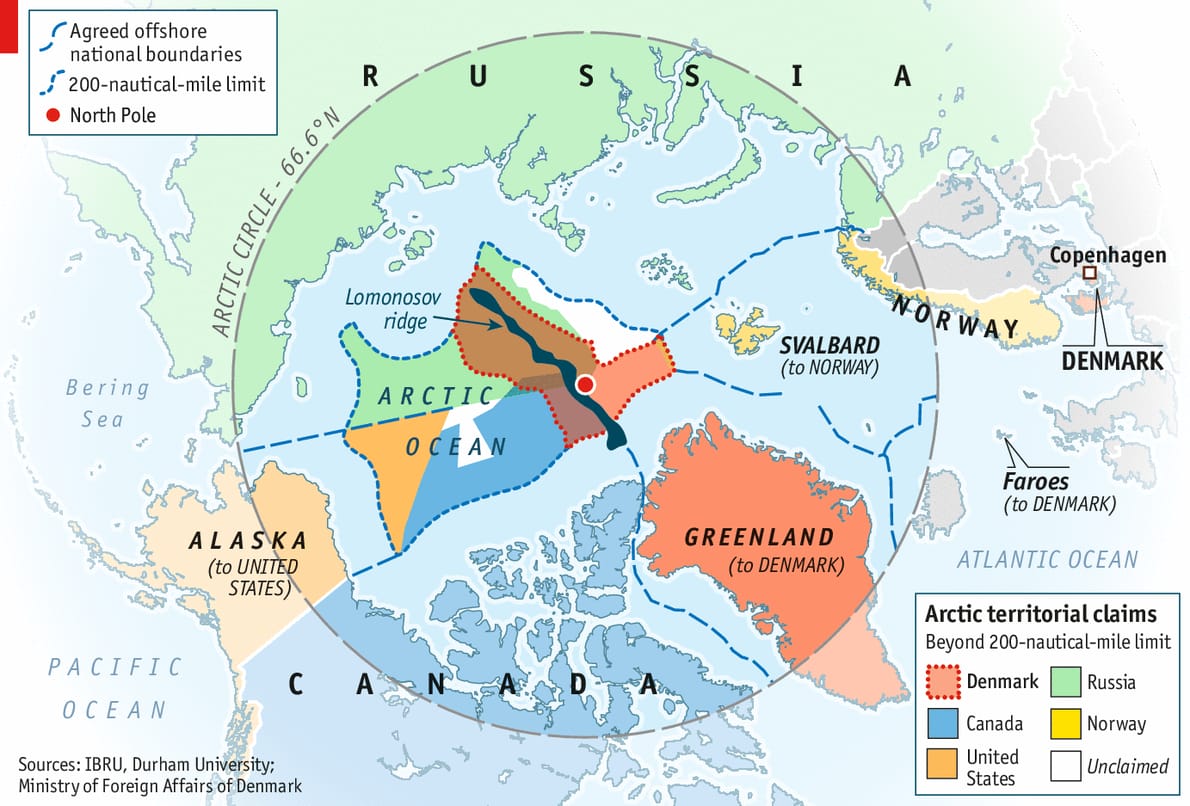
The Arctic itself remains a central strategic priority for Russia. Over the past two decades, Moscow has significantly expanded its military footprint in the region, reopened Soviet-era bases, and established permanent deployments, aided by receding ice. Russia also maintains the world’s largest icebreaker fleet, comprising more than 40 vessels, eight of them nuclear-powered, compared with the United States’ two operational icebreakers.
As tensions between Washington and Copenhagen continue and European unease grows, the Kremlin is observing developments closely. For Moscow, the Greenland dispute is not merely a regional disagreement but another signal of what it describes as the erosion of the international order—an erosion it is prepared to exploit to advance its strategic interests.